The Life and Legacy of Lenny Wilkens
With a touching pregame tribute at Rocket Arena before Thursday’s contest against Toronto, the Cavaliers honored the lifetime of Lenny Wilkens and mourned his passing earlier this week at age 88.
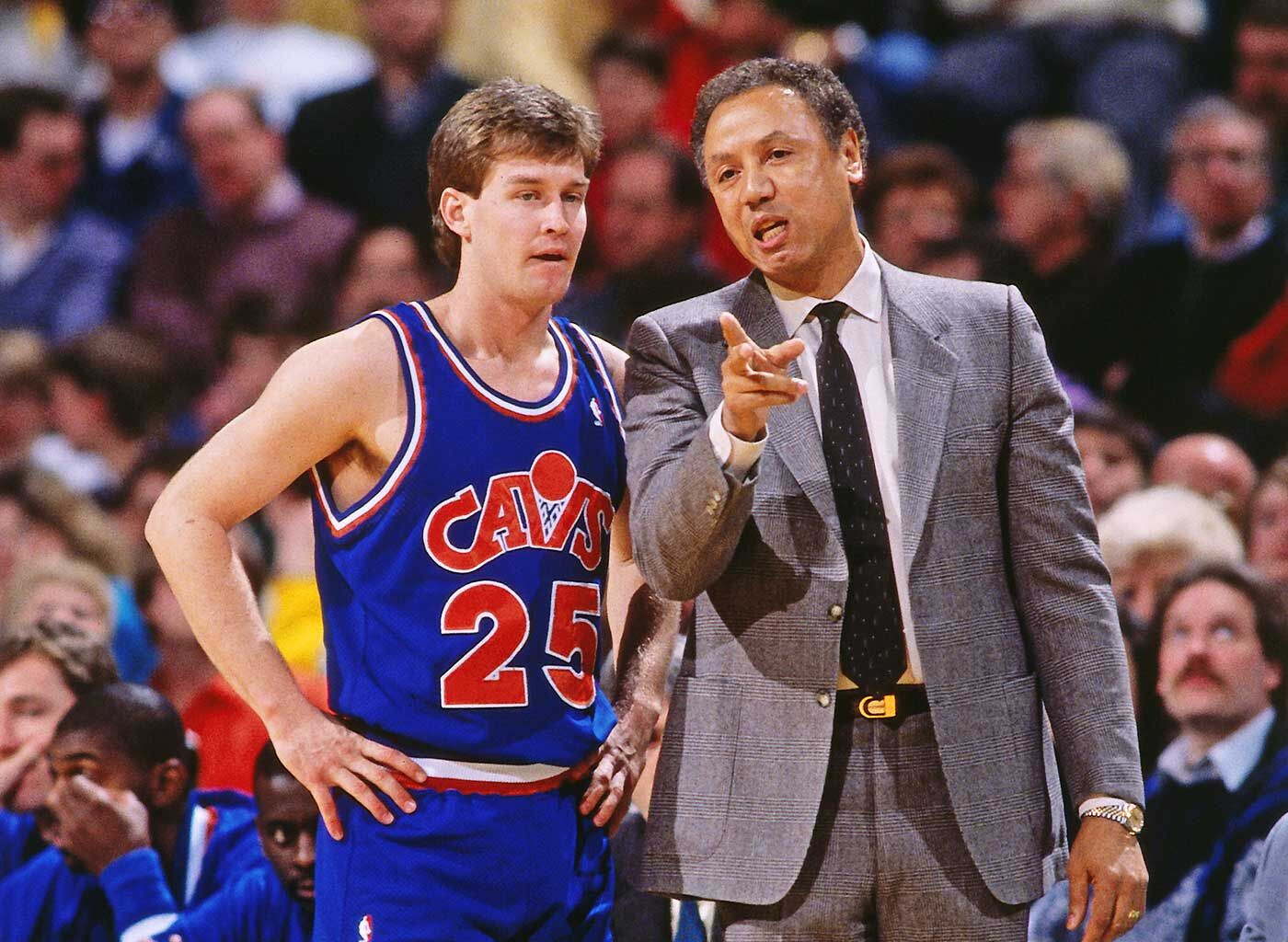
With a touching pregame tribute at Rocket Arena before Thursday’s contest against Toronto, the Cavaliers honored the lifetime of Lenny Wilkens and mourned his passing earlier this week at age 88.
If you ask any Cavalier – past or present – what’s unique about the organization, the answer’s almost always the same. They’ll say: ‘It’s like a family.’
This week, the Cavaliers lost a member of the family.
Our family thinks of him as “former Cavaliers Head Coach Lenny Wilkens.” But Cleveland was merely a chapter – (actually, two) – in his illustrious career as NBA royalty. Lenny was equally loved and will be missed by the Raptors family, the Hawks family, the Sonics family. The NBA family.
Wilkens basketball resume is prolific.
He’s in the Providence College Hall of Fame and the College Basketball Hall of Fame. He’s in the FIBA Hall of Fame, the U.S. Olympic Hall of Fame and a three-time member of the Naismith Memorial Basketball Hall of Fame as a player, coach and member of the “Dream Team.”
Wilkens was a 13-time All-Star – nine times a player, four as coach. He led the Seattle Supersonics to their only NBA Championship in 1979.
He played 15 seasons after the St. Louis Hawks took him with the 6th overall pick in 1960 – spending eight years with the Hawks, Sonics, Cavs and Blazers, averaging 16.5 points and 6.7 assists for his career. As a coach, he helmed the Sonics, Cavs, Atlanta Hawks, Raptors and Knicks – and when he retired in 2005, he did so as the winningest coach in league history with 1,332 victories.
Wilkens racked up 316 of those wins – still tops in team history – with the Cavaliers from 1986 through 1993, leading Cleveland to the playoffs in five of the seven years with a pair of 57-win seasons.

In his two seasons as a player with the Cavaliers, 1972-74, the lefty point guard led the team in scoring (20.5ppg) and assists (8.4apg) in his first year and in his second – the penultimate of his playing career – he averaged 16.4 points and again led the team in assists (7.4).
As he was being presented with yet another accolade – this time as a member the Cavaliers Wall of Honor’s Class of 2022 – the hoops legend recalled how he got his start back in Brooklyn, NY.
He talked about how his dad passed away when he was five years old, how he got his strength from his mother, and how the priest of his local Catholic parish – Father Manion – turned him on to sports to keep him out of trouble. He became an altar boy because they said he couldn’t learn Latin. He delivered groceries to Jackie Robinson.
“I definitely feel that I’ve been blessed along the way,” Wilkens said. “You know, we become who we surround ourselves with. Those people have a huge influence on our life. And I’ve been one of the lucky ones.”
Lenny Wilkens’ love affair with Cleveland actually got off to a rocky start.
He already had a Hall of Fame bona fides when he was traded to the Cavaliers in 1972, dealt by the Sonics along with Barry Clemens in exchange for Butch Beard. But Wilkens had no intention of joining “the Cadavers,” and he let the Seattle fans and media know it. It wasn’t until Nick Mileti and Bill Fitch flew to the Pacific Northwest to personally sell him before he OK’d the deal.
Already an accomplished 12-year veteran when he arrived, Lenny had been a player-coach with the Sonics, leading them to 47 wins in his final season in Seattle. He was immediately named team captain of the young Cavaliers, who were still in their infancy as a franchise. And he and Fitch didn’t always see eye-to-eye.
In a tale that’s completely unthinkable in today’s NBA, Wilkens recalled the time – after a long, fruitless road trip – the team arrived back in Cleveland and took busses directly to practice at Baldwin-Wallace, leaving wives and families at the airport. After practice, Fitch tormented them with repeated wind-sprints.
Lenny, the team’s leader, accomplished veteran and former NBA head coach did the work along with everyone else and didn’t say a word afterward – to his teammates or to Fitch. Eventually, it drove Fitch – the notorious taskmaster – crazy. And he wanted to know what was on Lenny’s mind.
“I said to (Fitch): ‘What did you teach us tonight?’ And he kind of just looked at me. I said, ‘What did you teach us? You punished us because we’re not very good, but you didn’t teach us anything.’ I said, ‘We’ll run through a wall for you if you’re going to teach us something.’ And hopefully we learned from each other, because after that, things got a little bit better.”
“Bill loved the game, but it didn’t come across to his players,” said Wilkens. “And I could see that.”
Even in the twilight of his playing career as a Cavalier, Wilkens put up excellent numbers. And although those teams weren’t very good – dropping 50-plus games in both seasons – he left an indelible mark on the team’s prized youngster, the top overall pick of the 1971 Draft: Austin Carr.
”Lenny was like a mentor to me, because he was so much more than a great basketball player. He was a great man,” said A.C. “And I think what shows his greatness as a person and a player is how many franchises he's been with and how he’s left a mark and left a standard with each one of them. It shows you what he was all about. He was a professional, all the time – the way he carried himself, the way he dressed.”
Carr laughed about how people often underestimated the cerebral Wilkens’ and his laid-back personality.
“He was very quiet person, but man, when he got to that place, I never wanted to get into an argument with him. His personality would change. That's how much of a competitor he was. He was cool, calm and collected until he got between the lines. When he got on that court, man, he’d just as soon snap your head off.”
Austin and Lenny only played two seasons together, although the Cavalier legends remained friends up until Wilkens’ recent passing.
“He was just a great person, a great family man and great basketball player,” smiled A.C. “But the one thing that I could never understand is how EVERYONE knew Lenny could not go to his right, but there's no way you could stop him from going left to where he wanted. He’d make that one little dribble to his right and players would go for it every time. They’d bite on that every single time!”
After leaving Cleveland, Wilkens was the player-coach of the Trail Blazers for one season before retiring. After taking a year off, Wilkens returned as a full-time head coach, taking over the Seattle Supersonics 22 games into the 1977-78 season. He led the Sonics to the ’78 Finals, where they lost to Washington in seven games. The next year, Wilkens got his revenge, topping the Bullets in five games and giving the Seattle franchise its only World Championship.
After eight seasons with the Sonics, the Cavaliers came calling. At his Wall of Fame induction ceremony, Lenny shared a story from the interview process.
“(Cavs GM) Wayne (Embry) called me to come interview for the job,” recalled Wilkens. “And I had seen Cleveland’s Draft. I knew who they were drafting and everything. I knew what the team was gonna look like. And so, I came in for a meeting, and we met with (Cavs owner) Gordon Gund and with a few people on Gordon’s staff. So, we were talking and one of the things they said to me was: ‘Well, we would like you to take a test.’ And I said, ‘What?’ They said, ‘Yeah, we'd like you to take a test.’ I said, ‘No, no.’ I said, ‘I'm the one who gives the test.’ And Gordon broke out laughing and said: ‘I want him.’”
Lenny Wilkens’ Cavaliers set the standard for the franchise moving forward. The team tasted brief playoff success during the “Miracle of Richfield” Era and George Karl’s squad that reached the postseason after a 2-19 start in 1985. But it wasn’t until the Wayne Embry / Lenny Wilkens partnership that the Cavs tasted sustained success.
The Cavaliers made the playoffs in each of Wilkens’ first season at the helm, falling to the Bulls twice. After an injury-plagued season in 1990-91, Cleveland returned to the postseason, winning 57 games and reaching the Eastern Conference Finals. The following season, the Cavs won 54 games but fell in the East Semifinals. Both playoff ousters came at the hands of Michael Jordan’s Bulls.
Under Wilkens’ tutelage, that team produced perennial All-Stars. Larry Nance made three All-Star appearances, Mark Price made four (including a First Team All-NBA nod) and Brad Daugherty appeared in the midseason classic five times.
Now the Cavaliers TV color analyst, Daugherty spoke of Lenny’s influence on his career.
“We had a really unique bond,” said Daugherty. “I think about Lenny Wilkins every day, from the standpoint of trying to emulate him, the way he carried himself. He just had so much class and dignity. Integrity. Character. All of those terms you use when you're talking about a superior type you person. So, I always try to try to comport myself in the same manner – where I try to be respectful, competitive, and do it in a sportsmanlike manner. And I just think of him. He just was beyond reproach.”
It’s been said that a team takes on the personality of its coach. And the Lenny Wilkens teams of the late-80s and early-90s certainly emulated its head coach – intelligent, skilled, tough, precise. Daugherty explained that there was a very simple reason for that.
“(Lenny) did not coach knuckleheads,” said Daugherty. “He didn't yell or scream. None of that. If you didn't listen, you were gone. He didn't tolerate nonsense. He wanted guys that were gonna listen, he wanted guys that were smart, that could adapt. And when he when he put a play in motion, he wanted guys that could execute it. If you were difficult, if you didn't play hard, he wasn’t gonna yell and scream at you. You were just gone. So, I think that's why the team ended up looking like Lenny. Because it mirrored the way he wanted his basketball team to look. He got rid of all the nonsense.”
The great Lenny Wilkens is survived by his wife of 63 years, Marilyn, his three children, Leesha, Randy and Jamee, and his seven grandchildren.
When he was honored in Cleveland back in 2022, Wilkens spoke about how proud he was of his family, how able to travel and coach with his son as an advisor for the South Korean men’s team in the 2010 Guangzhou Asian Games.
But he barely spoke about his mountain of accomplishments at the NBA level – where he was named one of the league’s 75 Greatest Players and 15 Greatest Coaches. What truly brought the biggest smile to Lenny’s face was reminiscing about his early days in Brooklyn, learning life-lessons from his first coach and mentor – Father Manion.
“Kids called him ‘Iron Hands,’ because when he grabbed you, you couldn't get away,” said Wilkens. “And he would grab me, and he’d say to me: ‘Who promised you?’ And I used to get upset, but then I began to understand what he meant by that. ‘Who promised you that life was going to be a cakewalk?’ It's not. Life's going to be what you make it.”
Related Articles
By the Numbers: 2026 Postseason
Check out the Wine & Gold's most memorable numbers and stats from the 2026 Playoff run.
A Review of the Season with Koby Altman
Cavaliers President of Basketball Operations Koby Altman took center stage at Cleveland Clinic Courts on Friday morning, just four days after the Wine & Gold were unceremoniously eliminated by the Knicks in the Eastern Conference Finals. He celebrated the franchise’s success – reaching the Conference Finals for the first time since 2018 – while acknowledging the shortcomings standing between the franchise and its ultimate goal.
Knicks Take Game Four at Rocket Arena
When the smoke cleared, the red-hot Knicks – who came into the series after an eight-day respite – had notched their 11th straight victory in the postseason had completely overwhelmed the Wine & Gold, running away with the 130-90 decision on Monday night at Rocket Arena and advancing to the NBA Finals for the first time since 1999.